 Bridgebase
 offers pairs games with a chosen partner and individual formats you enter alone.
Last updated ·Bridgebase lets you enter individual tournaments alone, while pairs events require a registered partnership. Bridge Base Online (BBO) includes human individual games with rotating partners and robot individuals where automated players occupy the other seats. Some pairs tournaments also accept a robot partner when their entry rules permit it. A solo entry therefore does not tell you whether your opponents will be people or robots. The distinction involves who registers together, who becomes your partner, and who sits opposite you. Formats sharing the Express name can have different partnership arrangements. Their full names and registration options identify whether you bring a partner, meet assigned partners, or play with robots.
In short: Express 4 Fast Boards - You & Robot seats two human competitors, each playing with an automated partner.
Entry Requirements and Table Seats
A pairs entry registers a partnership, while an individual entry registers one player whose partner follows the event format. These labels describe entry arrangements. They do not fully describe everyone seated at the table. An individual can play alongside other people, and a pairs entrant can sometimes partner a robot.
Partner selection and opponent selection are separate questions. A rotating human partnership, a fixed human partnership, and a human-robot partnership create different bidding relationships. All can appear within competitive bridge. The relevant game rules establish which arrangement applies, so the individual label alone does not establish an all-robot table.
Express and Daylong Partnership Arrangements
The Express family includes paired entry, rotating human partnerships, and human-robot contests. Daylong tournaments use automated players in every seat except the human entrant's. These formats separate the option to bring a chosen human partner from the option to enter alone.
| Game Format | How You Enter | Partner and Opponent Arrangement |
|---|---|---|
| Express 4 Fast Boards - Pairs | With a human partner or a robot partner | Paired entries with chosen partners |
| Express - 4 Fast Boards | Individually | Human partners change each hand |
| Express 4 Fast Boards - You & Robot | Individually | Two humans, each partnering a robot |
| Daylong Tournaments | Individually | One human and three robots |
| Partner Requirement | The selected format determines whether you arrange a partnership or enter alone. | |
Fixed Partnerships in Pairs Games
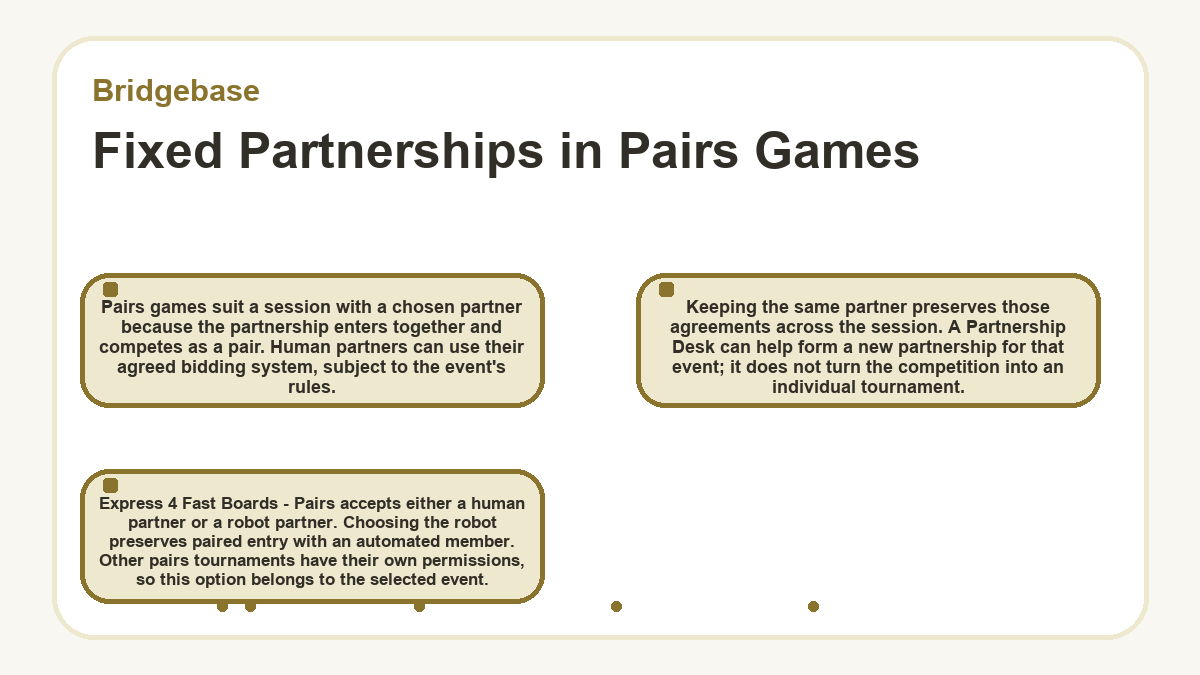
Pairs games suit a session with a chosen partner because the partnership enters together and competes as a pair. Human partners can use their agreed bidding system, subject to the event's rules. Keeping the same partner preserves those agreements across the session. A Partnership Desk can help form a new partnership for that event; it does not turn the competition into an individual tournament.
Express 4 Fast Boards - Pairs accepts either a human partner or a robot partner. Choosing the robot preserves paired entry with an automated member. Other pairs tournaments have their own permissions, so this option belongs to the selected event.
Rotating Partners in Human Individual Games
Human individual games provide partners through the event's movement, so a player can enter without arranging a partnership beforehand. In the ACBL (American Contract Bridge League) Clubhouse, partners and opponents change at the beginning of each round.
Express - 4 Fast Boards changes human partners after every hand. This game uses a preloaded two-over-one (2/1) convention card, and table chat is inactive. Its shared bidding framework supports play between newly assigned partners without a separate conversation before each deal.
Robot Individuals and Mixed Tables
Games with a robot partner can pit you against robot opponents or another human-robot pair, depending on the format. A Daylong table seats one human player and three robots. In the usual seating, the human occupies South, the partner occupies North, and the opponents occupy East and West. This arrangement removes the need to coordinate entry with another person.
Daylong competition compares human participants' results even though they play at separate robot tables. Daylongs also allow breaks and resumption within the event's completion window, separating your playing schedule from another human partner's availability.
Express 4 Fast Boards - You & Robot uses a mixed table with two human players, each partnered by a robot. The opposing human changes each board.
Daylong registration details identify the robot and its bidding system before play.
Can a Robot Partner Join Any Pairs Tournament?
A robot partner can join a pairs tournament only when that event permits robot registration, so the option is not universal. Tournament organizers control this permission when creating their games. A pairs event accepting robots allows a player without a human partner to enter through that route.
Robot substitutes serve a separate purpose during play. Directors can use them for missing players or sitouts even when robot-partner registration is disabled. Seeing a substitute robot at a table therefore does not establish that players could register with robots. Robot-partner charges also follow the particular event's terms; a price from another format does not establish this game's charge.
Partnership Desk and Confirmed Pairs Entries
The Partnership Desk connects players seeking a human partner for a particular tournament, through listings and invitations. Players can add their names or invite someone already listed. In ACBL Clubhouse pairs games, players can request a match at the start by selecting "Match me with someone at start" before adding their names. A name on its list indicates someone looking for a partner, rather than a completed partnership entry.
An invitation requires the invited partner's acceptance, and confirmation identifies the registered pair. The Entries list shows accepted partnerships. Both players need to be online for the invitation exchange. Scheduled pairs also depend on both partners being present when the game starts; registration alone does not supply an absent human partner.
An enabled offline-partner warning alerts the online player about a missing human partner before the start. Organizers can change its timing or disable it. Human-robot pairs do not receive this warning.
Swiss Teams and the Second Partnership
Swiss Teams requires a partnership within a team, but a registered pair can receive assigned teammates if it does not select another pair. A Swiss Teams side consists of two partnerships. Partner and teammate are different roles: your partner plays alongside you, while the other partnership contributes to the same team's results.
Team registration begins with the pair. The player who invited the partner becomes the Team Leader and can invite the other partnership. If the leader does not select teammates, the system assigns them when the tournament begins. Sitouts can occur when the number of entered pairs is odd.
Partnership Practice and Solo Declarer Games
Bidding and teaching tables support practice with another player, while solo declarer games allow card-play practice without a human partner. Bidding tables focus on the auction; teaching tables cover bidding and play. Their value to a partnership comes from practicing agreements together, without requiring entry into a scheduled pairs competition.
Just Declare supplies predetermined contracts, removing the bidding phase. Bridge Master presents instructional deals with the player as declarer and a solution explaining the intended play.
Entry Restrictions Beyond Finding a Partner
Tournament eligibility, account access, and payment remain separate conditions after the partnership arrangement is established. The registration page displays the game's restrictions and entry options. An individual format removes the need to bring a partner; it does not remove membership requirements or masterpoint limits where an event applies them. ACBL Clubhouse games require ACBL membership and an ACBL number on your BBO account for eligibility checks and award reporting.
BB$ is the in-game currency used for paid tournament entries. Paid events remain available on Basic membership, while eligible free-play activities can use its daily deal allowance. Premium expands access to free-play areas and includes the ability to start Social Bridge tables and team matches. An invited guest can play without using their daily allowance under the applicable guest arrangements.
Guest access applies to the invited activity. Joining an unrelated open table can fall under Basic's daily deal allowance.
Bridgebase FAQs
Does Human Declares Let Me Play Every Hand for My Robot Partnership?
Human Declares lets you declare contracts won by your side, including contracts where your robot partner would normally declare. In a Daylong using this setting, you normally sit South and temporarily move to North when North is declarer. You return to South after that hand. When the opponents win the contract, your side defends.
What Does Best Hand Mean When I Play With a Robot Partner?
Best Hand means your hand contains at least as many high-card points as any other hand at the table. It concerns the deal, rather than whether your partner is human or automated. Many Daylongs use this setting, while other variations do not. Hand distribution does not determine this high-card-point comparison, so the label does not describe every aspect of your cards.
Why Can My Daylong Partnership Receive a Different Deal From Another player's Table?
Daylongs using Deal Pools can supply different deals for the same board number at different tables. The pool contains multiple deals for a board as an anti-cheating measure. Comparing board numbers alone therefore cannot establish that your robot partnership received the same cards as another player's partnership.
Can I Invite a Human Partner Into an Instant Robot Tournament?
No. You enter an Instant Robot Tournament alone, with a robot partner and two robot opponents. The competition compares your results with recorded results from previous tournaments. Other human competitors appear in the scoring comparison, while the robot players provide your actual partner and opponents.
How Can I Understand What My Robot Partner Expects From a Bid?
Bid explanations show how the robot interprets the auction and your possible calls. Clicking a bid displays its meaning; hovering over a possible call shows the robot's interpretation before you choose it. The game registration details can also identify the robot and its bidding system. Agreements you normally use with a human partner do not establish this game's robot bidding meanings.
What Happens If I Exceed the Decision Clock in Express Individual Games?
Express - 4 Fast Boards allows 30 seconds for each bidding or play decision and replaces slow players with robots. Its human individual format therefore permits a robot substitute during play. The game also allots five minutes per board and automatically adjusts incomplete boards. These timing rules belong to this Express format; they do not apply to every solo game.